Saturday, July 30, 2011

63 - Healing a Blind Man

John 9:1-9:41
Who is the sinner?


The man blind from birth?  His parents?


Jesus, for healing on the Sabbath?  Or the Pharisees, who refuse to see what is right in front of their eyes?


Jesus healing the blind man - El Greco

Friday, July 29, 2011

62 - Walking on Water

Matthew 14:22-14:36
Several times before God has controlled the raging waters:  parting the Red Sea to let the Israelites out of Egypt; and likewise as the people cross the Jordan to enter the promised land. 


In this story Jesus has sent the disciples ahead across the sea of Galilee and stays to pray alone.  A storm arises, the disciple's boat cannot make progress, and they are afraid.  In the early morning light a figure appeared, and they were frightened.  But as so often happens when God speaks directly or through messengers, the first words are "fear not" or "do not be afraid."


Peter believes that if Jesus wills it that he can also walk on water, starts toward Jesus.  But he is overcome by fear, and starts to sink, only to be rescued by Jesus.  


Having seen this demonstration of Jesus power come to the only possible conclusion:  "Truly you are the Son of God."


Peter and Jesus on the water

When have you been afraid, and received reassurance from prayer, or in some other form?

Thursday, July 28, 2011

61 - Feeding the Five Thousand

Luke 9:1-9:36
Although labeled "Feeding the Five Thousand", this reading contains so much more:

  • An initial sending of the twelve to preach the Kingdom of God;
  • Herod hearing of Jesus' preaching, and wondering what was going on;
  • Jesus asking "who do the crowds say I am; who do you say I am?";
  • Jesus instructing his disciples that those who would follow him must "deny themselves and take up their cross daily";
  • The Transfiguration and appearance with Moses and Elijah.
The Transfiguration
This is the climax of his time in Galilee -- by the end of chapter 9 Jesus "set[s] his face to go to Jerusalem."

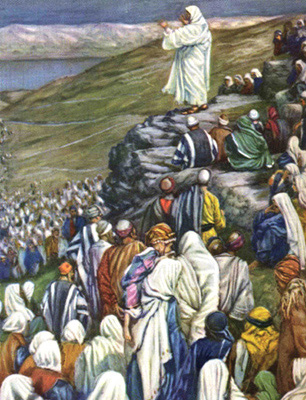
And so it is a time of intense teaching of who Jesus is, and what it takes to be a disciple.  He is heralding a new time -- the reign of God, not human governments, a time when his followers will be called upon to take very big risks to continue his ministry.  

Who do you say Jesus is?  What does it mean to you to take up your cross daily?

Wednesday, July 27, 2011

60 - Lost and Found

Luke 15:1-15:32
Jesus’ two tales of things lost and found, and of the return of the prodigal son lets those who will hear know how much each person, each soul, means to God.  In this case, he lets us know the meaning of the parable right up front:


"7Just so, I tell you, there will be more joy in heaven over one sinner who repents than over ninety-nine righteous persons who need no repentance." 


Jesus is the shepherd in the first part of the parable – the one who carries a full grown sheep back to the community.

Jesus is also the woman who sweeps through her house to find the one lost coin, and joins with her community to celebrate.

I have a special fondness for the story of the prodigal son, as one who was “away” from church for a number of years.  As I have learned more about this story and how it would have been heard in the culture of Jesus’ time and place, I am even more amazed at how much meaning is packed into little more than 500 words.

Jesus tells the now well known story of the prodigal (wastefully extravagant) son, who demands his share of his expected inheritance from his father, taking it to a far land, wasting the money with dissolute living.  He is in contrast to the faithful son who stays with his father helping to run the farm.

After spending his inheritance, reaching bottom and hiring himself out feeding pigs, he comes to his senses, and returns home, practicing his words of repentance.  Before he could get all the words out:

“22…the father said to his slaves, ‘Quickly, bring out a robe—the best one—and put it on him; put a ring on his finger and sandals on his feet. 23And get the fatted calf and kill it, and let us eat and celebrate; 24for this son of mine was dead and is alive again; he was lost and is found!’ And they began to celebrate.”

The older son is not happy at all.  This wastrel brother of his gets the big party, while he, the hard-working faithful son gets nothing.  The father replies:

31…‘Son, you are always with me, and all that is mine is yours. 32But we had to celebrate and rejoice, because this brother of yours was dead and has come to life; he was lost and has been found.’”  

The Rev. Dr. Kenneth Bailey, who spent much of his professional life living and teaching in the Middle East, has written several books looking at the New Testament through the eyes of the culture of the Middle East.  In The Cross & The Prodigal Dr. Bailey argues that this parable is really the story of God’s radical love for us, later expressed on the cross.   

According to Dr. Bailey, the very idea of a son asking for his share of the inheritance indicates he wishes his father was dead; only on his father’s death would he be entitled to his share. 

His father complied with his request, and liquidated one-third of his estate in just a few days.  His father showed unconditional love in this act. 

When the son returns, he is not required to work as a slave, or to sit outside the village or the father’s house, as might be expected.

Instead, the father races to meet him.  This is undignified and humiliating in the extreme, Dr. Bailey tells us, and this is as good a representation of God incarnate Christ as we can find. 

The father has compassion on his son, embraces and kisses him.  We have just witnessed complete and unconditional reconciliation, which all of humanity experiences through Christ’s journey to the Cross and beyond. 

The Return of the Prodigal Son - Rembrandt
How do you read these stories?  Who do you identify with the most? 

Tuesday, July 26, 2011

59 - The Good Samaritan

Luke 10:25-10:37


In one of the best known stories in scripture, Jesus weaves an elaborate tale to answer yet again the question, "am I my brother's keeper."  And he makes it clear that we are all brothers and sisters.  All of us.  Every one.


Once again the scribes (lawyers) are trying to trip him up.  What does it take to have eternal life?  As he frequently does, Jesus turns the question back on them.  What is written in the law?  The lawyers quote the law: "You shall love the Lord your God with all your heart, and with all your soul, and with all your strength; and your neighbor as yourself."


Then the lawyer asks the key question:  "And who is my neighbor."  


We usually think of our next door neighbor, perhaps the people in our community.  In certain cases, we consider our fellow countrymen our neighbor.  Here, Jesus reaches way beyond the family or religious or national ties.


It is striking that Jesus makes the Samaritan the hero of the story.  Instead of having a faithful priest or Levite come to the aid of a Samaritan, it is the despised one who shows mercy, and goes the extra step by arranging longer term care with the innkeeper.  If Jesus were telling the story to 21st century Americans, he might well make a member of the Taliban the hero.


The Good Samaritan - Jan Van Scorel
Bono, lead singer for U-2 and well-known poverty activist, frequently says -- "in the global village, we are going to have to start loving a lot more people."


Who do you understand your neighbor to be?

Monday, July 25, 2011

58 - The Kingdom of Heaven

Matthew 13:1-13:58


[REVISED]


You can read the pedantic discussion below, or go read a really good sermon about the sower parables, here


Chapter 13 contains another of Jesus' major discourses, expounding on the Kingdom of God through a series of parables.  He explains to his disciples why he uses parables -- those who are good soil, who are prepared to hear of the Kingdom, will understand.  


But the disciples must be careful about making judgments about who hears and who does not -- about the wheat and the weeds.  God will sort them out in the end, and the "weeds" may serve God's purpose.


Through a series of similes, Jesus gives more clues:  the Kingdom of God can grow to great size from small seeds or yeast; or the Kingdom may be hidden and be discovered; or be like a fishnet, from which the good are retained and the bad discarded.  


Jesus is sketching out a Kingdom very different from the royal nation of David, and the disciples may say they understand, but, like us, do not entirely comprehend what Jesus is saying.

Sunday, July 24, 2011

57 - Sermon on the Mount - Pt 2

Matthew 6:5-7:29


New Testament scholar N.T. Wright argues in Jesus and the Victory of God that the Sermon on the Mount primarily was meant to provide instruction to Jews on "how to survive and be faithful to YHWH in a time of great stress and ambiguity, a time when many thought the climax of Israel's history was upon them."   He was telling his followers not to treat God as a suzerain to be bribed with fancy worship, but rather to regard God as Father, and act accordingly.


But it turns out that Jesus sermon is generally applicable as a universal ethic:

  • Be simple, not ostentatious, with your prayer, your fasting, your almsgiving
  • Know that your heart is where your treasure is
  • Fear not, trust in God to provide
  • Don't judge others, lest you be judged
  • Do unto others as you would have them do unto you
  • Beware of false prophets - you shall know them by their products

And Jesus provided a form for regular prayer.  It was very simple, with three petitions acknowledging God as father and seeking God's kingdom, and three petitions acknowledging our dependence on God, the necessity of forgiving others, and asking God's protection.  

Lord's Prayer in Aramaic
At times we have difficulty deciphering Jesus' teaching in parables and agricultural references.  But in the end, it's really pretty simple.  Not easy, but simple.  

Saturday, July 23, 2011

56 - Sermon on the Mount - Pt. 1

Matthew 5:1-6:4


Jesus, like Moses, goes to the mountain to bring God's teaching to his disciples.  The Sermon on the Mount, along with the four other major discourses by Matthew, lay out the Kingdom of God.


Power and privilege may go to the wealthy and content, but those who are poor (in spirit), or who mourn, or those who are gentle, not power hungry, and those who hunger for righteousness/justice are the ones who are truly blessed.  Those who show the virtues of mercy, purity, peacemaking, and justice are also blessed.  And those who suffer for following Jesus will also be blessed.


The people of God's kingdom are to be a light to the world.  They are not only to follow the letter, but also the spirit of the law.  Anger is as bad as murder; lust is as bad as adultery.   The disciples are instructed to turn the other cheek, to pray for their enemies, to give generously, and to go the extra mile.  These instructions are hard for us, but imagine if the whole world could really behave this way.  That would be heaven!   

Friday, July 22, 2011

55 - Baptism and Temptations

Matthew 3:13-4:17


John has been preaching repentance, and baptizing those who want to change their way.  Jesus embraces John's rejection of the teachings of the Pharisees and Sadducees.  And Jesus is declared to be God's son, in language reminiscent of Isaiah 42:1 -- "Here is my servant...I have put my spirit upon him; he will bring forth justice to the nations." 


Jesus being baptized - Guido Reni
Immediately he is led to the wilderness, and tempted by Satan.  After 40 days of fasting, will he use his position and power for himself, or trust in God?  Will he make a stone into bread for himself, or trust in God to provide, as God provided manna for the Hebrew people wandering in the wilderness?  Will he seek to just save himself, or trust in God to provide what is necessary to take the promised land?  Will Jesus take possession of and power over all the earth, only in exchange for worshiping Satan?  Jesus answers again by reference to the statement of the law in Deuteronomy:  "Worship the Lord your God, and serve only him."


Satan tempting Jesus
 Jesus is ready to start his ministry.

Thursday, July 21, 2011

54 - John the Baptist

Luke 3:1-3:20


John begins his ministry, pointing to Isaiah, as Jesus did later when he started his ministry.  


He says that "all flesh" shall see the salvation of God -- meaning all humanity.


And what is necessary for true repentance?  Changing the way you live -- turn around and give one of your cloaks to anyone who has none, and likewise with food.  Not cheating when collecting taxes, nor extorting from the weak.    


John the Baptist preaching
He promised that Jesus, not he, was the Messiah, the Christos.  While John could baptize with water, Jesus would baptize with the Holy Spirit.


John of course does not know when to be quiet, and he also calls out Herod for his misbehavior.  This gets John thrown into prison, which of course came to no good end for John.

Tuesday, July 19, 2011

52 - Gabriel's Message


Luke does as he promises, to set out an "orderly account" of the events of Jesus life, teachings, death and resurrection, and later, in Acts, of the birth and spread of the early church.

At the beginning, God's angels announce first to Zechariah and then to Mary what was about to happen.  Zechariah and his wife Elizabeth, who are, like Abraham and Sarah aged and barren, are to have a son, John, who will:

"turn many of the people of Israel to the Lord their God.  With the spirit and power of Elijah he will go before him, to turn the hearts of parents to their children, and the disobedient to the wisdom of the righteous, to make ready a people  prepared for the Lord."

Annunciation by Henry Turner
Then the angel Gabriel appears to Mary, and says, as in other angelic appearances:  "Do not be afraid."  He tells her astounding news:

"you will conceive in your womb and bear a son, and you will name him Jesus.  He will be great, and will be called the Son of the Most High, and the Lord God will give to him the throne of his ancestor David.  He will reign over the house of Jacob forever, and of his kingdom there will be no end."

Mary responds with what we have come to call the Magnificat, from the first word in Latin, as her soul "magnifies" the Lord. 

This beloved canticle is said or sung frequently in the daily offices, and too little in other services.  Mary praises God for his mercy on those who fear him, for scattering the proud, and bringing down the powerful from their thrones.  Like the prayer of Hannah, she praises God for having lifted up the lowly, and [having] filled the hungry with good things (Hannah says:  He raises up the poor from the dust; he lifts up the needy from the ash heap...).

Finally John the baptizer is born, and Zechariah praises God with another canticle called Benediuctus Dominus Deus in the Book of Common Prayer:  Blessed be the Lord God of Israel.

 What do the Magnificat and the Benediuctus Dominus Deus mean to you?

Monday, July 18, 2011

51 - The Word Became Flesh

John 1:1-1:18
"In the beginning was the Word, and the Word was with God, and the Word was God. He was in the beginning with God. All things came into being through him, and without him not one thing came into being. What has come into being in him was life, and the life was the light of all people."


What an audacious, nay, outrageous claim.  That the Word was from the beginning.  That the Word was with God, and at the very same time the Word was God.  Nothing happened, nothing came into being without this Word.


"And the Word became flesh and lived among us, and we have seen his glory, the glory as of a father’s only son, full of grace and truth."


How can this Word, this perfect intelligence/being/creator/beyond-our-imagining take on the grimy flesh of human beings, who live only a short and miserable life, and return to dust?  How can this be?


"It is God the only Son, who is close to the Father’s heart, who has made him known."


Sunday, July 17, 2011

50 - The Day of Judgment

Malachi 1:1 - 2:13
Malachi 2:14 - 4:5

It is not clear to me why Malachi should be considered one of the top 50 passages in the Hebrew scripture.

Why not one of these:
Deuteronomy 15:7-11
or
Job 31:16-23
or
Psalm 72
or
Micah 6:1-8
or
Amos 5:18-24

Let justice roll down like waters, and righteousness like an ever-flowing stream

What passage do you think should have been included?

Saturday, July 16, 2011

49 - The Story of Jonah

Jonah 1:1 - 2:7

Jonah 2:8-4:11

One of the most humorous books of scripture, Jonah tells the delightful tale of a reluctant prophet who delivers the briefest of prophetic warnings, and sulks when he is successful.

Interspersed among the prophet who runs away when God calls, a giant fish in whose belly the prophet recites psalms, and a king who commands the animals to fast, is a story of God's grace being available to all, including non-Hebrews, of the importance of repentance, and a reminder that God is in charge.

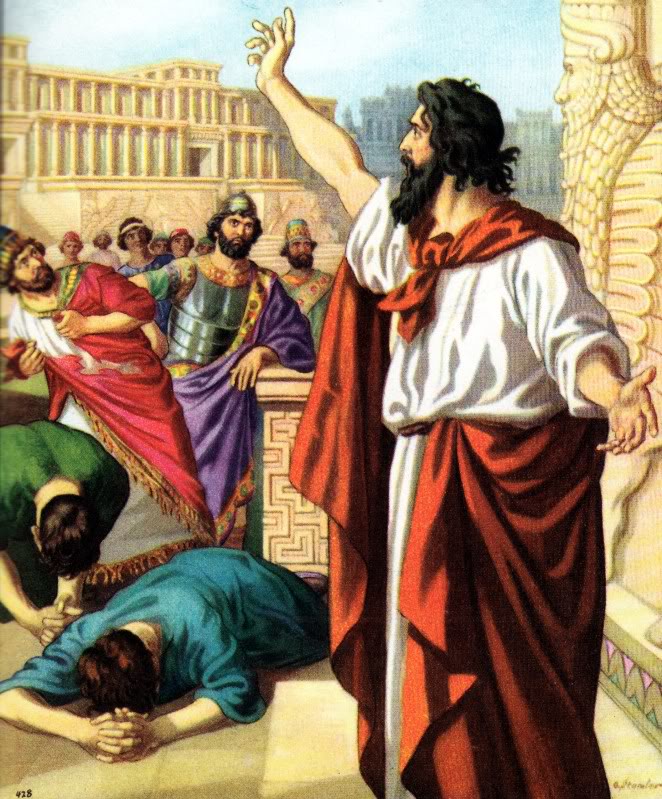
Jonah preaching to Nineveh